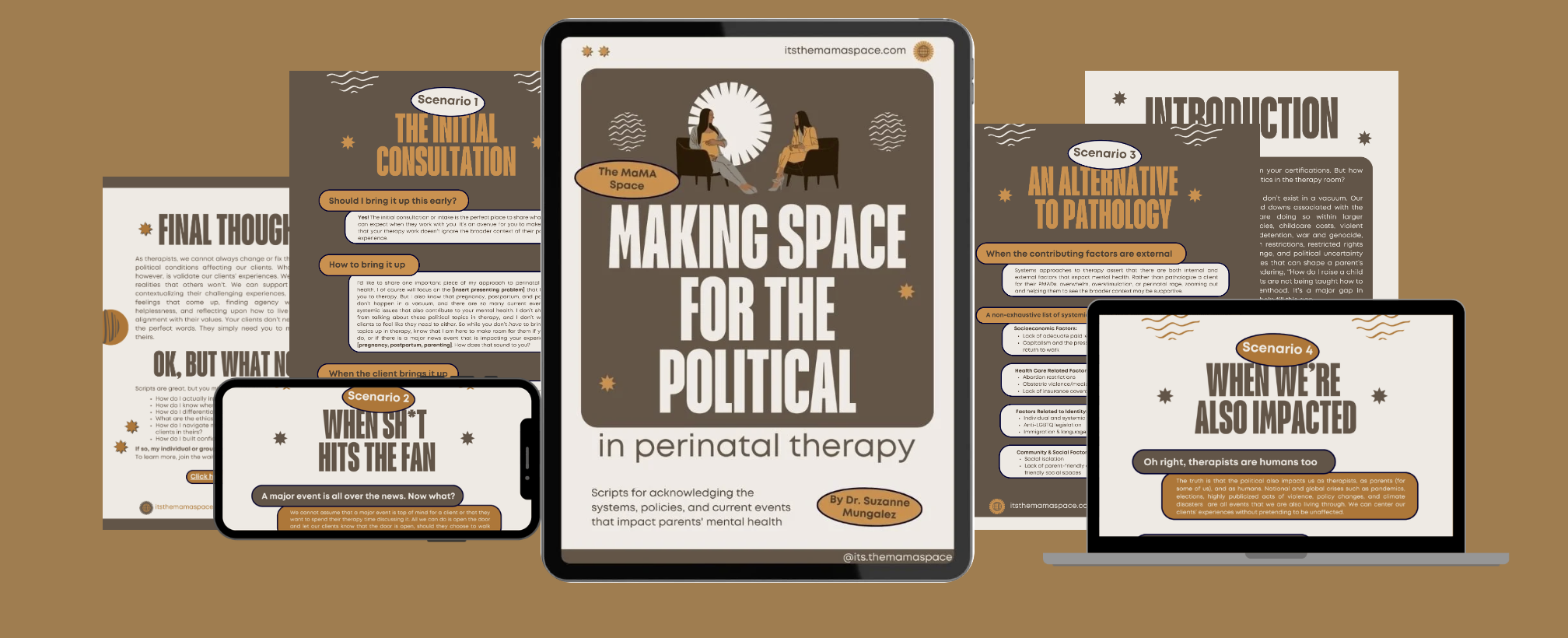
Making Space for the Political in Perinatal Therapy
Scripts for acknowledging the systems, policies, and current events that impact parents' mental health
When the state of the world enters the therapy room, will you know what to say?
Let’s face it—pregnancy, postpartum, and parenting don’t happen in a vacuum. Our clients are navigating the transition to parenthood while also navigating a world shaped by oppressive systems and political uncertainty. Our clients’ experiences of motherhood are influenced by the state of the world, often exacerbating or even being the cause of their perinatal distress.
So how do we, as perinatal therapists, make space for all of this in the therapy room?
Download this free guide for practical scripts and language you can adapt to acknowledge the political realities that impact our clients.

Addressing the gap in perinatal care
As perinatal therapists, we receive training in perinatal mood and anxiety disorders, reproductive challenges, birth trauma, and the many emotional challenges of becoming a parent.
But current trainings don’t provide any guidance around how to address the political and systemic realities that affect clients within these transitional experiences.
This leaves many of us feeling uncertain of what to say, and it leaves clients with a critical gap in their perinatal mental health care.
This guide is one step towards beginning to fill that gap.

This guide is for you if…
You work with clients navigating pregnancy, postpartum, infertility, reproductive decisions, or the transition to parenthood
You recognize that political decisions, systemic inequities, and current events can significantly impact perinatal mental health
You hear clients express fear, grief, anger, or ambivalence about bringing children into this current world
You want to acknowledge the social and political context of your clients’ lives
You worry about saying the wrong thing, centering your own politics, or not knowing what to do when a sensitive topic comes up
You’re ready to move beyond treating perinatal distress as if it exists in isolation from what’s happening in the world

Because motherhood is political, & so is therapy.